



13 November 2026
Beyond white: anthracite, wood-effect finishes and RAL colours give your home character. We show the options and...
When comparing window quotes, you come across abbreviations such as Uw, Ug and Uf everywhere. The most important figure is the Uw value – it tells you how much heat is lost through the entire window. We explain what is behind the numbers, which requirements typically apply and how much you can save with better windows.
The U-value (thermal transmittance) indicates how much heat energy in watts is lost per square metre of a building component for every degree of temperature difference between inside and outside. The unit is W/(m²K). The rule is: the lower the value, the better the window insulates. The “w” stands for “window” – so the Uw value describes the complete window made up of frame, glass and glass edge.
The Uw value is calculated from these values and the proportions of the areas. Manufacturers usually state it for a reference window of 1.23 × 1.48 m. Small windows with a high frame proportion have a slightly worse value, large windows often a better one.
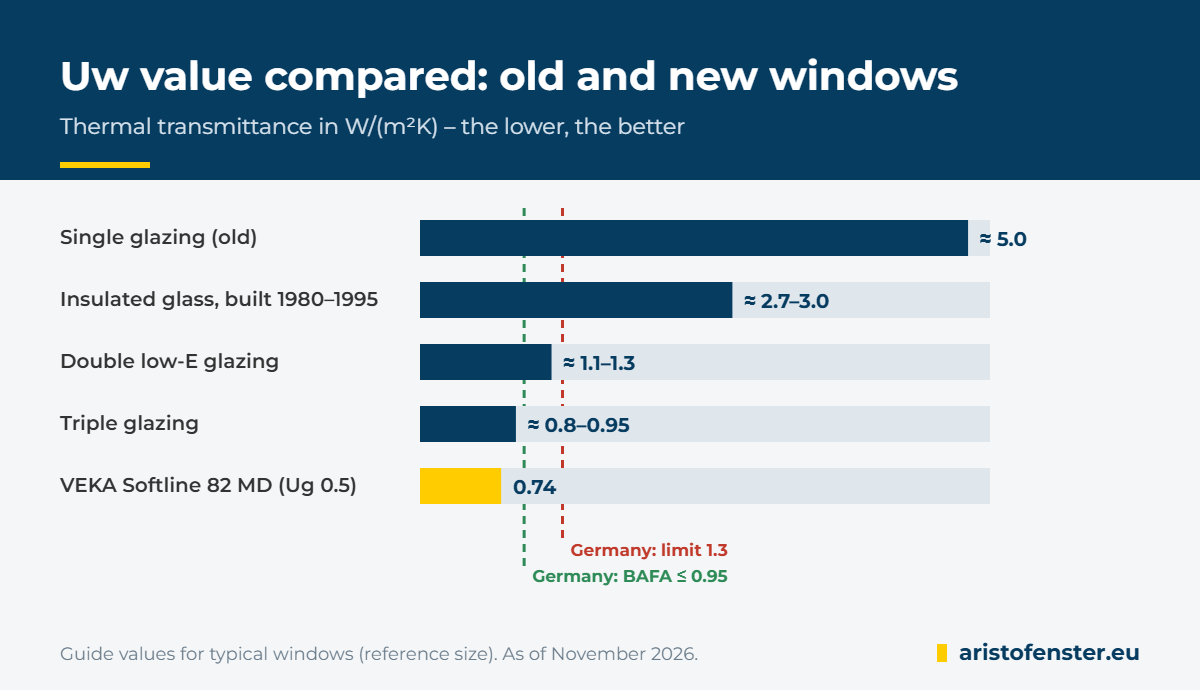
Requirements depend on the country. In Germany, for example, the Building Modernisation Act (GModG), which replaced the Building Energy Act in July 2026, requires a Uw value of no more than 1.3 W/(m²K) when windows are replaced. Anyone applying for BAFA funding must achieve a much better Uw ≤ 0.95 W/(m²K). In Poland, the technical building regulations (WT 2021) call for 0.9 W/(m²K). Passive houses use windows of around 0.8 W/(m²K) and below.
Which Uw value do your windows need?
We calculate Uw values for your window sizes and show you which option pays off for funding and heating costs.
A detached house has 15 m² of windows. The old insulated glass windows have a Uw value of around 2.8, the new triple-glazed windows 0.8 W/(m²K). The difference of 2.0 W/(m²K) across 15 m² means 30 watts less heat loss per degree of temperature difference. Over a typical Central European heating season, this amounts to roughly 2,000 to 2,500 kWh less heating energy per year – several hundred euros, depending on energy prices. On top of that comes comfort: the inner glass surface stays warmer, there are fewer draughts and less condensation.
Note: the example is a simplified estimate. The actual saving depends on the building, heating habits and solar gains.
Our PVC windows with triple glazing reach Uw values down to 0.74 W/(m²K) (VEKA Softline 82 MD). You will find details on our page PVC windows. We explain the differences between glazing types in Double or triple glazing.
Energy-efficient windows at a fair price
Send us your dimensions – we will prepare a quote with exact Uw values.
Beyond white: anthracite, wood-effect finishes and RAL colours give your home character. We show the options and...
A few simple tasks a year keep windows tight and running smoothly. Here is how to care...
Misted panes on the inside, the outside or between the glass? We explain what condensation on windows...