




13 November 2026
Beyond white: anthracite, wood-effect finishes and RAL colours give your home character. We show the options and...
Road traffic, trams or aircraft: noise is one of the biggest nuisances at home. New windows can make a real difference – if they are chosen correctly. In this guide we explain sound insulation classes, show which components really make things quieter and give tips for peaceful rooms.
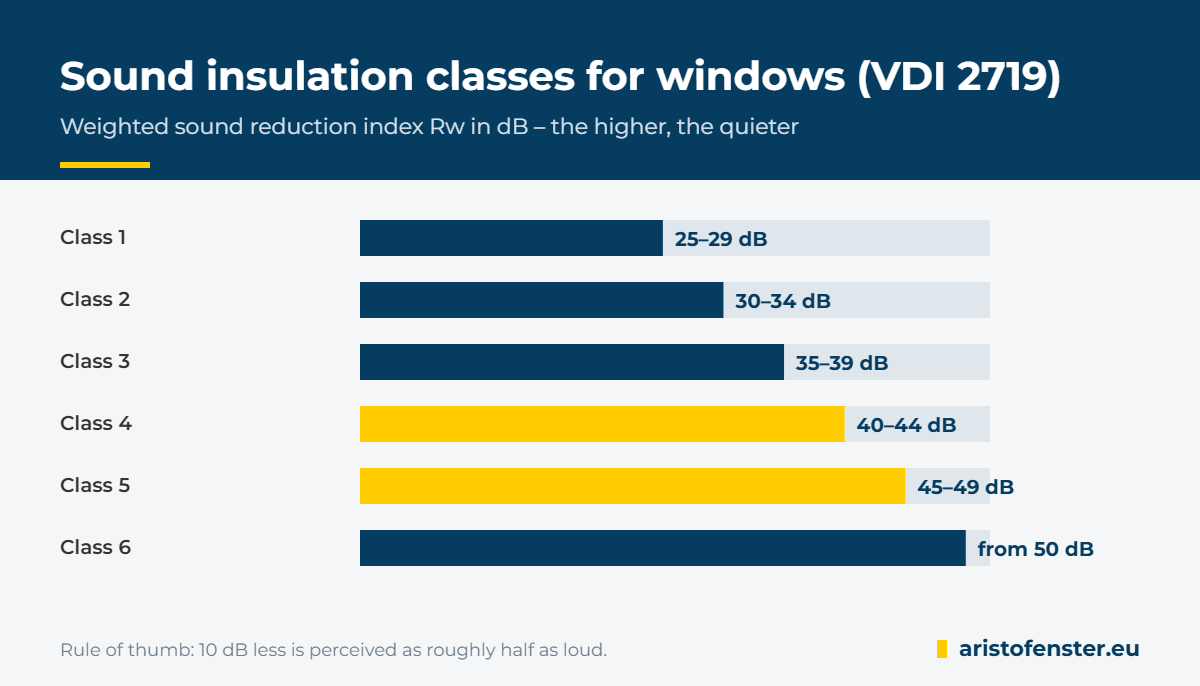
The sound insulation of a window is stated as the weighted sound reduction index Rw in decibels (dB). The higher the value, the better. Important: decibels are a logarithmic scale. Even 10 dB less is perceived as roughly half as loud. A window with 42 dB instead of 32 dB therefore makes a clearly audible difference.
Many manufacturers use the classification from the German guideline VDI 2719, which divides windows into six sound insulation classes. Modern triple-glazed windows usually already reach class 2 to 3. For homes on main roads or railway lines, class 4 or higher is advisable.
Quieter living on a busy road?
We recommend the right sound insulation class for your location and combine glass, profile and roller shutter perfectly.
A soundproof window is of little use if there is an old, uninsulated roller shutter box above it. Make sure that roller shutter boxes or external blind covers are also sound-insulated – or opt for front-mounted systems outside the wall. Trickle vents should also be acoustic versions so that the home stays quiet and well ventilated.
Tip: it is worth going one class higher for bedrooms – peace and quiet has a particular effect on rest there.
You will find our window systems with sound insulation data on the page PVC windows. Read more about glazing in Double or triple glazing.
Soundproof windows at a fair price
Send us your dimensions and describe the noise situation – we will prepare a no-obligation quote.
Beyond white: anthracite, wood-effect finishes and RAL colours give your home character. We show the options and...

A few simple tasks a year keep windows tight and running smoothly. Here is how to care...
Misted panes on the inside, the outside or between the glass? We explain what condensation on windows...